In a world of Agentic AI, Where do Fulfillment Partners Fit In?

I spent last week at Seven Figure Agency’s Intensive, and if you weren’t there, here’s the one-line summary: agents are the topic. Not “agencies”, but agentic AI. The Association has built out roughly 30 of them for members to plug into their operations, covering everything from client onboarding to campaign reporting to, yes, ad management itself.
I came home impressed. I also came home more convinced than I’ve been in a while of something we’ve believed from day one: agencies need a real fulfillment layer behind them, not just another tool.
Those two reactions aren’t in tension. Let me walk through why.
The productivity case for agents is real
I’m not going to pretend agentic AI is a fad. It isn’t and aggressively changes the way we’re doing business. Generative AI usage in at least one marketing workflow has jumped from 51% of marketers in 2024 to 87% in 2026, and the automation is moving well past content drafting into execution. Google Performance Max already drives 58% of paid search campaign optimization decisions, and agencies running AI-managed PPC bidding are seeing a 37% reduction in wasted spend and a 50% lift in ROI versus manual bid management. That’s not a rounding error. That’s the kind of number that gets an agency owner’s attention in a room full of other agency owners, which is exactly what happened at the Intensive.
Seven Figure Agency’s own team has been writing about this shift too, arguing that AI is changing agencies in 2026 in ways most owners haven’t fully clocked yet — new service lines, new margins, new expectations from clients about turnaround time. I agree with the framing. Where I differ is in the conclusion a lot of people in that room seemed to be drawing. An off-the-shelf agent stack is close to a substitute for a managed fulfillment platform. But it’s not, and the data backs that up.
The gap between “adopted” and “in production” is enormous
Here’s the stat that stuck with me most from the week. And it wasn’t even from the conference floor, I looked it up afterward. Roughly 79% of enterprises have adopted AI agents in some form, but only about 11% are actually running them in production. That’s a 68-point gap between piloting agents and trusting them with real client budgets (Digital Applied, 2026). Adoption headlines are cheap. Production headlines are the ones that matter to an agency owner whose name is on the client contract.
Gartner’s research points at exactly the same gap from a different angle. Their poll of more than 3,400 organizations found that more than 40% of agentic AI projects will be canceled by the end of 2027. Not because the technology doesn’t work, but because the cost, complexity, and unclear ROI of standing up and governing an agent stack catch up with teams after the demo excitement wears off. The same Gartner research predicts that in 2026, one-third of companies will actually damage customer relationships by deploying AI prematurely. For an agency, “damaged customer relationships” means a churned SMB client and a bad reference call.
Ad management specifically has a trust problem right now
This is the part that matters most for what we do. Ad ops isn’t a low-stakes place to let an autonomous agent run unsupervised. More than half of advertisers, 54%, report that generative AI has already contributed to a decline in media quality in their accounts. Price floor errors from AI mismanagement are skewing bids, forcing advertisers to overpay while publishers get shortchanged on inventory value. And the executives closest to these systems aren’t naive about it. Roughly a third worry openly about hallucinations, and about 28% are specifically worried about giving agents too much autonomy over decisions that touch real ad dollars.
None of that means the agents the association shared with members are bad tools. Some of them are genuinely good at narrow tasks. Things like drafting ad copy variants, summarizing performance data, flagging anomalies for a human to review. What it means is that “delegate ad management to an agent” and “use agents to make ad management faster for the humans accountable for it” are two very different claims, and the conference conversation kept blurring them.
Where I landed
My actual takeaway from the week wasn’t “ignore the agents.” It was that the winning model right now is agents plus a platform built around accountable humans and proven infrastructure. Not agents replacing that layer. Even Seven Figure Agency’s own team has been candid that agencies are still figuring out where AI creates leverage versus where it creates risk. That’s a “still figuring out” phase, not a “solved” one.
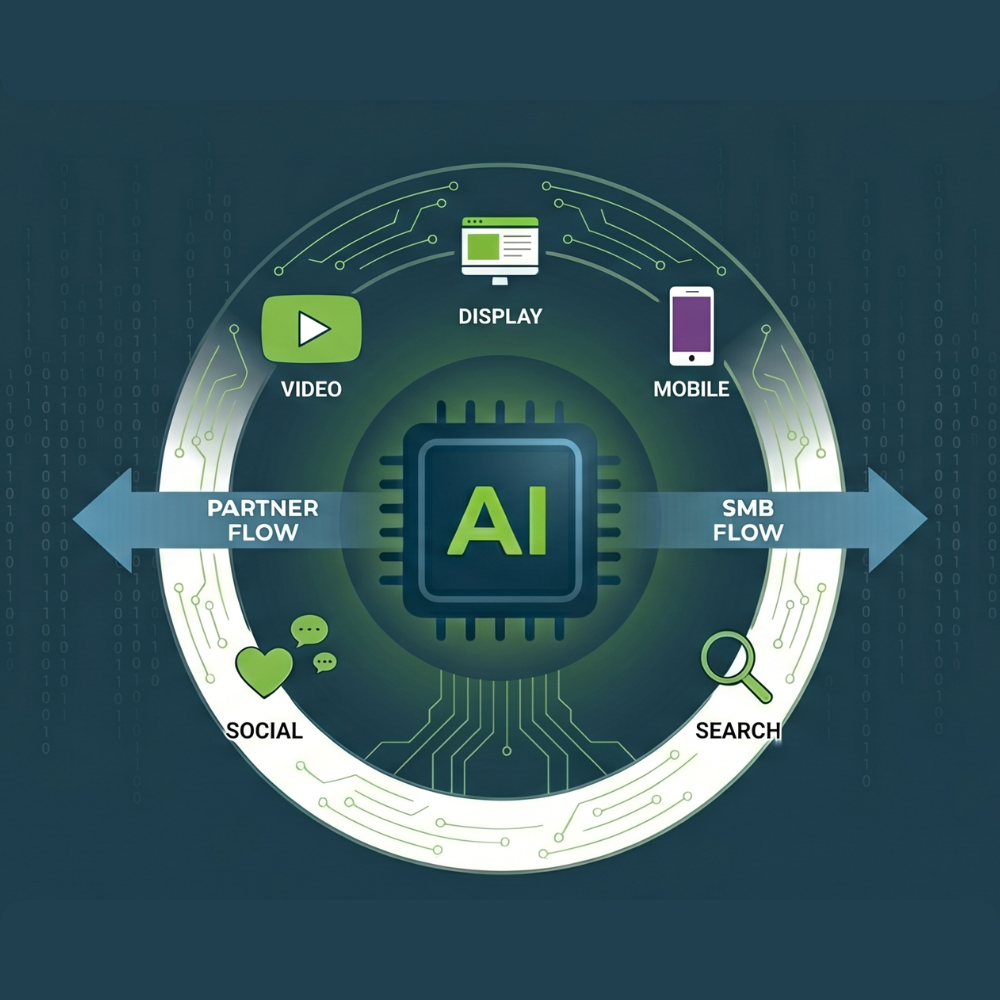
That’s precisely the gap iPromote fills. We use AI-assisted media planning to build full omnichannel campaign structures. That means the audiences, creative, targeting, budget pacing, conversion events all built in minutes instead of weeks. But every campaign is backed by 20+ years of platform expertise, a team that’s actually accountable for the outcome, transparent flat-rate pricing, and reporting your clients will actually log into. We’re not asking you to hand your SMB clients’ ad budgets to an unsupervised agent stack you have to build, govern, and debug yourself. We’re the fulfillment layer that lets you offer search, social, programmatic, video, and CTV under your own brand, created in minutes, without staffing up a team of platform specialists or betting client budgets on a technology that Gartner itself expects a third of implementations to fail at.
The agents will keep getting better. I said as much to a few agency owners in the hallway between sessions. But “better” and “ready to run ad management unsupervised” aren’t the same milestone, and the data on production deployment, project cancellations, and media quality all say we’re not there. Until we are, agencies need a partner who’s already doing this at scale, not a stack of point solutions they have to wire together and hope holds.
Ready to see what a real fulfillment platform looks like?
If your agency is weighing whether to build an in-house AI ad-ops stack or partner with a platform that’s already solved for scale, margin, and accountability, let’s talk. See iPromote’s omnichannel advertising platform in action or start a partner conversation today.